

A Deep Exploration of Enamel Biology, Its Limitations, and Modern Solutions
If you browse health forums or social media, you may come across advertisements for products claiming to “regrow tooth enamel.” You may find toothpastes that claim to “rebuild” enamel, supplements that claim to “trigger natural regrowth,” and mouthwashes that promise to “repair enamel damage overnight.”
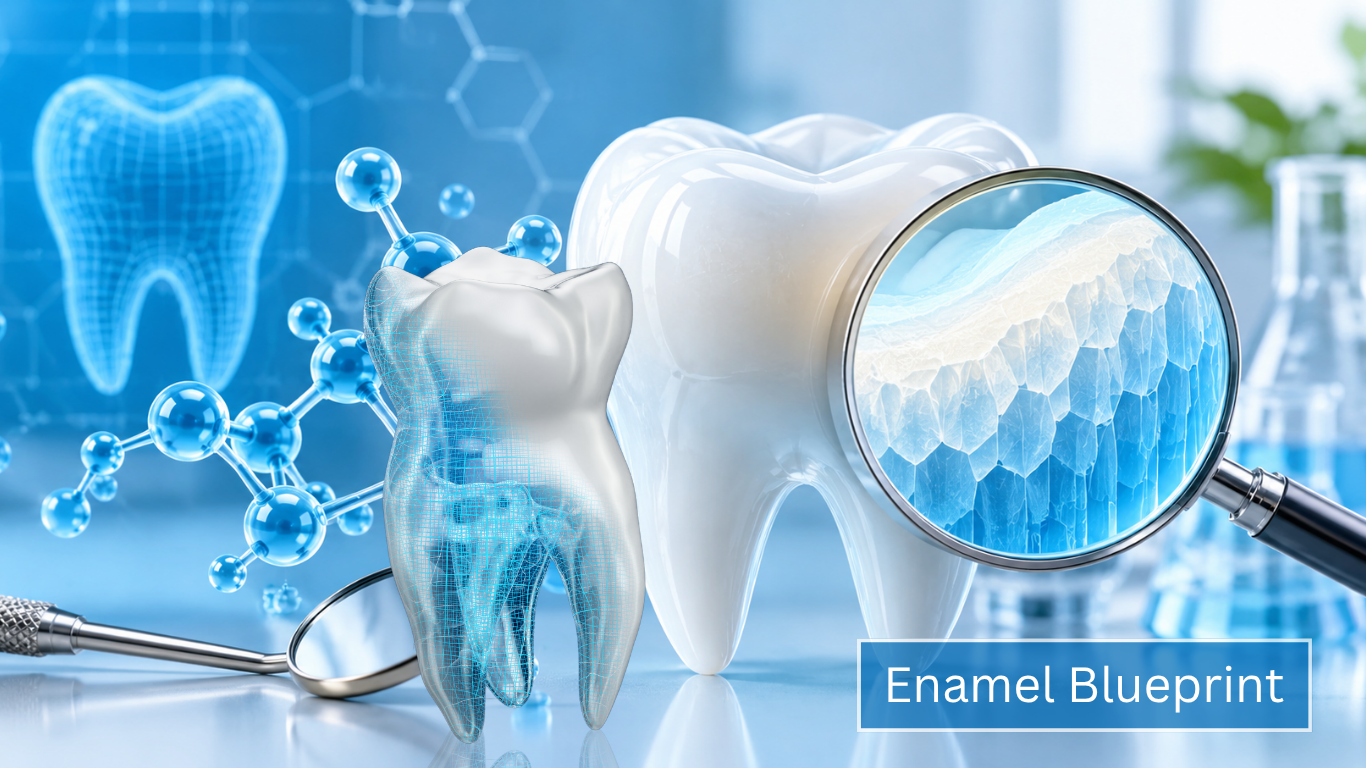
These claims can sound convincing, but there is an important scientific distinction: human dental enamel does not naturally regenerate once it has been structurally lost.
The American Dental Association (ADA) has explained that lost enamel cannot simply be replaced by the body. Scientific research also distinguishes between remineralizing existing enamel and regenerating completely new enamel tissue.
Key Points
- Human enamel does not naturally grow back once it has been physically lost.
- Enamel is produced by specialized cells called ameloblasts, which secrete the enamel matrix during tooth development.
- After enamel formation is complete and the tooth erupts, ameloblasts are lost. Mature enamel is therefore acellular, meaning it contains no living cells capable of producing new enamel.
- Remineralization is possible in early, superficial mineral damage, but it is not the same as replacing enamel that has been physically lost.
Unlike tissues such as skin and bone, which contain living cells capable of participating in repair, mature enamel lacks the cellular machinery required to rebuild itself after significant structural loss.
To understand why, it helps to examine the specialized biological process responsible for enamel formation.
The Lifetime of an Ameloblast
During tooth development beneath the gums, the body produces specialized cells called ameloblasts. These cells can be thought of as microscopic biological builders. Their primary role is to secrete and organize the enamel matrix, which later becomes highly mineralized.
Mature enamel consists predominantly of mineral, especially calcium-phosphate crystals arranged primarily as hydroxyapatite. This highly mineralized structure makes enamel the hardest tissue in the human body.
However, hardness does not make enamel indestructible. Although it is exceptionally resistant to wear, enamel can still crack, fracture, erode, and dissolve under repeated mechanical or acidic stress.
What Happens to the Enamel-Forming Cells?
Once enamel formation is complete and the tooth erupts into the mouth, the ameloblasts responsible for creating it are lost.
As a result, mature tooth enamel is acellular. It contains no living cells or blood vessels and has no direct nerve supply.
Because the cells responsible for producing enamel are no longer present, mature enamel does not have the biological machinery required to manufacture new enamel after substantial tissue has been lost.
If enamel is physically lost through decay, fracture, or erosion, the body cannot simply grow a new layer to replace it.
That is why prevention is so important.
The most effective strategies for protecting enamel include brushing twice a day with fluoride toothpaste, limiting frequent exposure to acidic and sugary foods and drinks, and maintaining regular dental checkups.
Supportive habits can also help. For example, rinsing your mouth with water after consuming acidic foods or beverages can reduce acid exposure. When appropriate, using a straw for acidic drinks may reduce direct contact with the teeth. It is also generally advisable to avoid brushing immediately after significant acid exposure, because the enamel surface may be temporarily softened.
Chewing sugar-free gum can stimulate saliva production, which supports the mouth’s natural buffering and remineralization processes.
Together, these habits can help preserve existing enamel and reduce the risk of irreversible structural damage.
Remineralization vs. Regeneration: Clearing Up the Confusion
If enamel cannot grow back, why do dentists talk about remineralization?
The answer lies in the difference between repairing mineral loss within existing enamel and creating entirely new enamel tissue.
Enamel is primarily composed of tightly organized hydroxyapatite crystals. When acids produced by oral bacteria or introduced through acidic foods and beverages lower the pH around the teeth, minerals such as calcium and phosphate can leave the enamel.
This process is known as demineralization.
Fortunately, early demineralization can sometimes be reversed before a physical cavity develops.
Your mouth has a natural defense system:
- Salivary buffering:Saliva helps neutralize acids and contains calcium and phosphate ions that contribute to maintaining the mineral balance of enamel.
- Mineral redeposition:When conditions in the mouth become favorable again, calcium and phosphate can be redeposited into areas of partially demineralized enamel.
- The fluoride advantage:Fluoride promotes remineralization and can become incorporated into the mineral structure at the enamel surface, producing mineral phases that are more resistant to future acid attack.
This process can strengthen existing enamel, but it does not recreate a substantial layer of enamel that has already been physically lost.
The Takeaway for Structural Health
Remineralization is a chemical process that can help repair early mineral damage within existing enamel. Under suitable conditions, it may help arrest or reverse very early non-cavitated lesions before a physical hole forms.
It should not be confused with enamel regeneration.
For mild enamel demineralization without cavitation, appropriate home care—such as regular brushing with fluoride toothpaste, reducing frequent sugar and acid exposure, and following a dentist’s recommendations—can support remineralization.
However, once enough tooth structure has been lost to create a physical cavity, significant fracture, or other structural defect, remineralization alone generally cannot restore the tooth’s original shape and structure. Professional dental treatment may then be necessary.
How to Know When to See a Dentist
Seek professional dental advice if you notice warning signs such as:
- Visible holes, pits, chips, or cracks in your teeth
- Persistent dark or discolored areas
- Sensitivity to hot, cold, or sweet foods and drinks
- Persistent or recurring tooth pain or discomfort
These symptoms can have several causes, so they should not be used to diagnose a dental condition on your own. A dentist can examine the tooth, determine the extent and cause of the damage, and recommend appropriate treatment.
How Modern Dentistry Replaces Lost Tooth Structure
When enamel or other tooth structure has been significantly lost, modern dentistry can use restorative materials such as composite resin, lithium-disilicate ceramics such as e.max, and zirconia to restore the tooth.
These materials do not cause enamel to regrow. Instead, they replace or protect lost tooth structure.
A composite resin filling may be appropriate when decay or damage is limited to a relatively small area and sufficient healthy tooth structure remains.
When more extensive tooth structure has been lost, restorations such as an onlay, overlay, or crown may be considered, depending on the location and extent of the damage, the bite, aesthetic requirements, and other clinical factors.
Composite resin is widely used for small to moderate restorations. It can provide excellent aesthetics and allows relatively conservative treatment, although it may stain, wear, or require replacement over time.
Lithium-disilicate ceramic, commonly associated with products such as e.max, can provide excellent aesthetics, translucency, and strength. It is used for various restorations, including veneers, inlays, onlays, and crowns, depending on the clinical situation.
Zirconia is a very strong ceramic material with excellent fracture resistance. It is frequently used in areas exposed to substantial chewing forces. Modern translucent zirconia materials can also provide improved aesthetics compared with earlier generations.
A crown covers most or all of the prepared clinical crown of a tooth, helping restore its shape, function, strength, and appearance. An onlay or overlay can cover selected portions of a tooth while preserving more healthy tooth structure when clinically appropriate.
The choice of restoration and material depends on many factors, including the amount of remaining tooth structure, tooth position, bite forces, aesthetic requirements, oral health, and the dentist’s clinical assessment.
Most importantly, none of these restorative materials actually regrows natural enamel. They are engineered replacements designed to restore and protect damaged teeth.
Future Directions: Could Enamel Ever Be Regrown?
Although mature human enamel cannot currently regenerate naturally after substantial structural loss, researchers continue to investigate ways of recreating enamel or enamel-like structures.
Areas of active research include regenerative medicine, stem-cell biology, tissue engineering, protein- and peptide-based mineralization systems, and advanced bioactive materials.
Researchers are exploring whether it may eventually be possible to reproduce aspects of the biological environment responsible for enamel formation or guide minerals into highly organized enamel-like structures.
These approaches are scientifically exciting, but producing an enamel-like material in a laboratory is very different from safely regenerating functional natural enamel on a patient’s tooth.
Any future therapy would need to demonstrate that the regenerated material has appropriate mineral organization, adhesion, durability, mechanical properties, biocompatibility, and long-term safety before it could become routine clinical treatment.
For this reason, predictions about exactly when true enamel regeneration might become widely available should be treated cautiously. Scientific breakthroughs do not follow a guaranteed timeline, and promising laboratory research may require many years of further development and clinical testing—or may not ultimately translate into routine treatment.
Conclusion
The most important distinction is simple:
Enamel can be remineralized when early mineral loss occurs, but enamel that has been physically lost cannot currently be naturally regrown by the human body.
Remineralization strengthens and repairs the mineral structure of enamel that is still present. Regeneration would require the body to produce entirely new enamel tissue—something mature human teeth cannot currently do.
For now, the best strategy is to protect the enamel you already have through good oral hygiene, fluoride exposure, sensible dietary habits, and regular professional dental care.
When structural enamel loss has already occurred, modern restorative dentistry can replace and protect the missing tooth structure—but it does not make natural enamel grow back.
The Chemistry of the “Enamel Blueprint”: Why Your Teeth Cannot Regrow
A Deep Exploration of Enamel Biology, Its Limitations, and Modern Solutions If you browse health forums or social media, you may come across advertisements for
Dental Crown vs. Filling: Which Treatment Does Your Tooth Need?
If you have a cavity, chipped tooth, cracked tooth, or old restoration that needs repair, you may be wondering: Do I need a filling or
Why Does My Tooth Hurt When I Bite Down? 8 Common Causes & What to Do
A tooth that hurts when you bite down can be caused by something relatively simple, such as a filling that needs adjustment, or by a
Custom Sports Mouthguards vs. Store-Bought: Which Is Better?
In a sporting-goods store or if you browse online you can find a wide variety of mouthguards. A few are taken straight from the package,

Bleeding Gums Aren’t Normal: 7 Signs of Gum Disease You Shouldn’t Ignore
While you are brushing your teeth, you notice a small amount of pink in the sink. It’s easy to ignore, especially if your gums aren’t

Gum Disease and Heart Health: What’s the Connection?
If you’re considering ways of looking after your heart, it’s probably not the first thing that comes to mind to brush and floss. However, since