

If you have a cavity, chipped tooth, cracked tooth, or old restoration that needs repair, you may be wondering: Do I need a filling or a dental crown?
Both treatments can restore a damaged tooth, but they do different jobs.
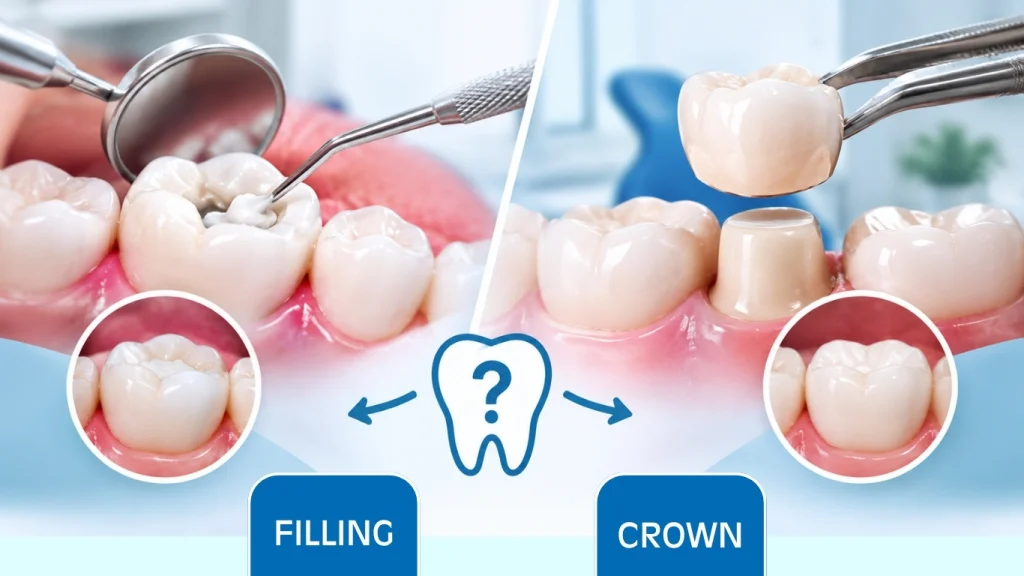
A filling repairs a localized area of damage when enough strong, healthy tooth structure remains. A dental crown covers and protects a tooth that needs more extensive structural support.
The decision is not based only on how large a cavity looks. Your dentist will also consider how much healthy tooth remains, where the damage is located, whether the tooth is cracked, the amount of pressure the tooth receives when you bite, previous dental work, and whether the tooth has undergone root canal treatment.
Here is what you need to know about dental crowns vs. fillings and how a dentist determines which treatment is appropriate.
Dental Crown vs. Filling: Quick Comparison
Feature | Dental Filling | Dental Crown |
Main purpose | Repairs a localized damaged or decayed area | Covers and protects a weakened tooth |
Commonly used for | Small to moderate cavities and limited damage | Extensive damage, weakened teeth, large failing restorations, or certain fractures |
Coverage | Replaces only the damaged portion | Covers most or all of the prepared visible tooth |
Healthy tooth required | Needs enough surrounding tooth structure for support | May be used when less strong tooth structure remains |
Tooth preparation | Usually more conservative | Requires reshaping the tooth for the crown |
Number of visits | Often completed in one appointment | May require more than one appointment depending on the technique |
Cost | Generally lower | Generally higher |
Tooth-colored options | Yes | Yes |
Best choice | Depends on the condition of the tooth | Depends on the condition of the tooth |
Neither treatment is automatically “better.” The right restoration is the one that can predictably repair and protect your particular tooth while preserving healthy structure whenever possible.
What Is a Dental Filling?
A dental filling repairs an area of a tooth damaged by decay, wear, or limited breakage.
During a filling procedure, the dentist removes the damaged or decayed tooth structure, cleans and prepares the area, and restores the missing portion with an appropriate filling material.
Tooth-colored composite resin is commonly used because it can be matched to the natural appearance of your tooth.
A filling generally works best when the damage is limited and the remaining tooth is strong enough to support the restoration during normal chewing.
When Might You Need a Filling?
A filling may be appropriate when you have:
- A small or moderate cavity
- A limited chipped or damaged area
- Localized decay
- An old filling that can be replaced without requiring broader tooth coverage
- Enough healthy tooth structure to support the new restoration
One advantage of a filling is that treatment usually preserves more natural tooth structure than a full-coverage crown.
Many fillings can also be completed in a single appointment.
However, a filling has limits. If too much of the tooth has been lost or weakened, simply placing a larger filling may not provide the protection the tooth needs.
What Is a Dental Crown?
A dental crown, sometimes called a tooth cap, is a custom restoration designed to cover the prepared visible portion of a tooth.
Instead of filling one damaged area, a crown surrounds the tooth to restore its shape, function, appearance, and protection
.
A dentist may recommend a crown when the remaining tooth would benefit from more extensive coverage than a filling can provide.
Depending on your individual treatment needs, crowns can be made from materials such as ceramic, porcelain-based materials, zirconia, or other dental materials.
At Pinellas Family Dental, restorative options include Emax and zirconia crowns.
When Might You Need a Dental Crown?
A crown may be considered when:
- A large amount of tooth structure has been lost
- Extensive decay has weakened the tooth
- A tooth is cracked or fractured but can still be restored
- A large existing filling leaves limited healthy tooth structure
- A tooth has significant wear
- A previous restoration has failed and the tooth now needs additional protection
- A root canal-treated tooth requires additional structural protection
- Bite forces place the remaining tooth at increased risk of fracture
The purpose of a crown is not simply to cover a cavity. It is to provide a type of restoration appropriate for a tooth whose remaining structure needs greater protection.
How Does a Dentist Decide Between a Crown and a Filling?
There is no single measurement or rule that applies to every patient.
Two teeth can have cavities that appear similar but require different treatments because the location of the damage, remaining tooth structure, cracks, previous dental treatment, and chewing forces are different.
Your dentist considers several important factors.
1. How Much Healthy Tooth Structure Remains?
This is one of the most important considerations.
If a relatively small portion of the tooth is damaged and strong natural tooth remains around it, a filling may provide an appropriate repair.
As more tooth structure is lost, however, the remaining walls and chewing surfaces may become weaker.
At that point, placing an increasingly large filling may not provide the support the tooth needs. A crown or another type of restoration may then be considered.
The goal is not to choose the largest restoration possible. It is to preserve healthy tooth structure while giving the tooth enough support to function predictably.
2. Is the Tooth Cracked or Fractured?
A small chip and a structurally significant crack are very different dental problems.
Minor areas of damage may sometimes be repaired with composite material or another conservative restoration.
A tooth with a crack or fracture that weakens important parts of its structure may require more extensive protection.
A crown can cover the tooth and help protect the remaining structure from chewing forces when a full-coverage restoration is appropriate.
However, not every cracked tooth can be saved with a crown. The location and extent of the crack matter.
A crack that extends deeply into the root or makes the tooth non-restorable may require a different treatment.
That is why a cracked tooth should be examined rather than treated based on appearance alone.
3. Does the Tooth Already Have a Large Filling?
A tooth containing a large existing filling has less natural structure than an untouched tooth.
Over time, fillings and the surrounding tooth structure are exposed to repeated biting forces. An old filling may wear, leak, fracture, loosen, or develop decay around its edges.
Sometimes an old filling can simply be replaced.
In other situations, replacing one very large filling with another may leave the tooth vulnerable to fracture. A crown may then provide a more appropriate way to restore and protect the remaining tooth.
Your dentist will consider the condition of both the restoration and the tooth surrounding it.
4. Has the Tooth Had Root Canal Treatment?
A tooth that has undergone root canal treatment needs an appropriate final restoration to protect it and return it to function.
But not every root canal-treated tooth automatically requires exactly the same type of restoration.
The decision depends on factors including:
- Which tooth was treated
- How much tooth structure remains
- Whether the tooth has cracks
- How much biting pressure it receives
- The size of previous restorations
- The overall condition of the tooth
Back teeth such as molars and premolars often experience substantial chewing forces and may need cuspal coverage after root canal treatment.
Your dentist will evaluate the individual tooth and recommend the final restoration that provides appropriate protection.
5. Where Is the Tooth in Your Mouth?
Location matters because teeth perform different jobs.
Front teeth primarily help cut food and have important cosmetic considerations.
Premolars and molars are exposed to heavier chewing forces.
A restoration that works well for limited damage on one tooth may not provide enough support for extensive damage on another.
Your dentist will consider both the amount of tooth remaining and the forces the restoration will need to withstand.
6. How Does Your Bite Affect the Tooth?
Your bite—or occlusion—describes how your upper and lower teeth come together.
Some teeth experience greater forces because of bite patterns, tooth position, grinding, or clenching.
If a weakened tooth repeatedly receives heavy pressure, fracture risk may be greater.
Your dentist may therefore check your bite when deciding which type of restoration is likely to function best.
7. Do You Grind or Clench Your Teeth?
Bruxism—grinding or clenching—can place repeated stress on both natural teeth and dental restorations.
Signs may include:
- Worn tooth surfaces
- Chipped teeth
- Cracked teeth
- Jaw soreness
- Morning headaches
- Broken or worn restorations
If you grind your teeth, your dentist may factor those forces into the treatment plan.
Treating or managing the grinding may also be important for protecting your new restoration.
Large Cavity: Filling or Crown?
This is one of the most common questions patients ask.
A large cavity does not automatically mean you need a crown, but as more tooth structure is lost, it becomes increasingly important to evaluate whether the remaining tooth can support a filling.
Imagine repairing a wall.
If only a small section is damaged, repairing that section may be enough. But if much of the supporting structure is missing or weakened, simply making the patch larger may not provide adequate support.
Teeth work in a similar way.
Your dentist must evaluate what remains after the decay or damaged material has been removed, not simply what the cavity looks like before treatment.
Depending on the situation, the best treatment could be a filling, crown, another type of restoration, or—in cases of severe damage—additional dental treatment.
Is a Crown Better Than a Filling?
No.
A crown is not automatically a “better” version of a filling, and a filling is not simply a cheaper crown.
They are different treatments for different situations.
For a small cavity surrounded by strong tooth structure, a filling may be the more conservative and appropriate choice.
Placing a crown when a filling can adequately restore the tooth would generally require more tooth preparation than necessary.
On the other hand, repeatedly placing large fillings in a severely weakened tooth may not provide sufficient protection.
The objective is to choose the least extensive treatment that can predictably restore the tooth’s health, strength, and function.
Can a Filling Eventually Turn Into a Crown?
Yes.
A tooth that is appropriately restored with a filling today may need a crown years later if its condition changes.
For example:
- New decay may develop around an old filling
- The filling may fracture
- Part of the tooth may break
- Additional tooth structure may be lost during replacement of an old restoration
- Repeated dental treatment may leave less natural tooth remaining
That does not mean the original filling was the wrong treatment.
Dental restorations are not permanent for life, and a tooth’s needs can change over time.
Regular dental examinations help your dentist monitor existing restorations and identify problems before they become more extensive.
What Happens During a Dental Filling?
The exact procedure varies depending on your tooth, but a filling commonly involves the following steps:
1. Examination
Your dentist examines the tooth and may use dental X-rays when necessary to assess decay or other damage.
2. Numbing the Area
Local anesthetic may be used when appropriate to keep you comfortable.
3. Removing Damaged Tooth Structure
Decay and damaged material are removed while preserving healthy tooth structure whenever possible.
4. Placing the Filling
The tooth is prepared and the selected restorative material is placed.
5. Shaping and Bite Check
The restoration is shaped and polished, and your dentist checks how your upper and lower teeth meet.
Many fillings can be completed during one appointment.
What Happens During a Dental Crown Procedure?
A dental crown usually involves more preparation because the restoration must fit over the tooth.
Treatment may include:
1. Examination and Treatment Planning
Your dentist evaluates whether the tooth is restorable and whether a crown is the appropriate option.
2. Preparing the Tooth
Damaged or decayed areas are addressed, and the tooth is shaped so the crown can fit securely.
3. Digital Scan or Impression
A scan or impression records the shape of the prepared tooth and surrounding teeth.
4. Temporary Restoration When Needed
Depending on the crown process being used, a temporary crown may protect the tooth while the final restoration is being created.
5. Fitting the Final Crown
Your dentist checks the crown’s fit, contacts, appearance, and bite before securing it to the tooth.
Treatment time and number of appointments can vary depending on the tooth and crown fabrication process.
Does a Crown Hurt More Than a Filling?
Both fillings and crowns can typically be performed using local anesthesia when necessary.
Because a crown generally involves more tooth preparation than a small filling, your tooth or gums may feel different afterward.
Temporary sensitivity can occur following either procedure.
However, severe pain, swelling, pain that is getting worse, or discomfort that does not improve should be discussed with your dentist.
Sometimes postoperative discomfort is related to inflammation, the condition of the tooth itself, or the way the restoration contacts the opposing tooth.
How Long Do Crowns and Fillings Last?
There is no guaranteed lifespan for either restoration.
Both fillings and crowns can function for many years, but longevity depends on factors such as:
- Size of the restoration
- Dental material
- Location of the tooth
- Amount of healthy tooth structure
- Quality of your oral hygiene
- Bite forces
- Grinding or clenching
- Diet and habits
- Condition of the underlying tooth
- Regular professional dental care
A small filling in a healthy tooth faces very different stresses from a large filling in a heavily restored molar.
Likewise, a crown can eventually wear, loosen, fracture, or develop problems around its margins.
Regular dental examinations allow your dentist to monitor both types of restorations.
Can You Get a Cavity Under a Crown?
Yes.
The crown itself does not develop tooth decay, but the natural tooth underneath and around the edge of the crown can still develop decay.
Plaque can accumulate around the crown margin just as it can around natural teeth.
Good oral hygiene remains important after getting a crown.
Brush twice daily with fluoride toothpaste, clean between your teeth every day, and attend recommended dental examinations and cleanings.
If a crown becomes loose or you notice new sensitivity, pain, an unusual taste, or food trapping around it, have the area evaluated.
How Much Does a Crown Cost Compared With a Filling?
A dental crown generally costs more than a filling because it involves more extensive treatment and a custom-made restoration.
However, there is no single price that applies to every tooth.
Cost can vary according to:
- The tooth being treated
- Type and size of restoration
- Crown material
- Complexity of treatment
- Whether additional treatment is required
- Dental insurance coverage
- Individual dental office fees
Choosing treatment based only on the lowest initial price can be misleading.
The better question is:
Which treatment is appropriate for the condition of this tooth and offers a predictable way to restore it?
Your dental office can provide a treatment estimate and explain applicable insurance benefits or financing options after the tooth has been evaluated.
How Can You Make a Filling or Crown Last Longer?
Good daily habits can protect both your restoration and the tooth underneath it.
Brush twice a day
Use fluoride toothpaste and clean carefully around the edges of restorations.
Clean between your teeth daily
Floss or use another dentist-recommended interdental cleaning method.
Don’t chew ice or extremely hard objects
Hard objects can damage natural teeth, fillings, and crowns.
Address grinding and clenching
If you grind your teeth, ask your dentist whether treatment or a protective appliance is appropriate.
Don’t ignore a loose restoration
A loose crown or damaged filling should be evaluated before the tooth develops additional problems.
Attend routine dental examinations
Some problems around restorations cause few or no symptoms initially.
Professional examinations and appropriate dental imaging can help identify issues that may otherwise go unnoticed.
When Should You See a Dentist?
You don’t need to determine by yourself whether you need a crown or filling.
Schedule a dental examination if you notice:
- A visible cavity
- A chipped or broken tooth
- Pain while biting or chewing
- Persistent sensitivity to hot, cold, or sweets
- A cracked tooth
- A loose filling
- A loose or damaged crown
- Food repeatedly getting caught around a restoration
- Tooth pain that keeps returning
- Gum swelling near a tooth
- A tooth with a large restoration that feels different
These signs do not automatically mean you need a crown. They mean the tooth should be evaluated.
A dentist can examine the tooth, assess its remaining structure, check your bite, and take X-rays when appropriate before explaining your treatment options.
When Is It Urgent?
Contact a dental professional promptly for severe or rapidly worsening tooth pain, significant swelling, dental trauma, or suspected dental infection.
If swelling is spreading into the face or neck or makes it difficult to breathe or swallow, seek emergency medical attention immediately.
Filling or Dental Crown in Largo, FL? Visit Pinellas Family Dental
If you’ve been told that a tooth needs treatment—or you’re experiencing a cavity, chipped tooth, broken filling, or other dental damage—the first step is determining how much healthy tooth remains and what type of restoration can appropriately protect it.
At Pinellas Family Dental in Largo, Florida, Drs. Don and Amy Vespa and their team provide comprehensive restorative dental care for patients with damaged and weakened teeth.
Treatment options available through the practice include restorative dentistry and Emax and zirconia crowns, with recommendations based on each patient’s individual oral health needs.
Whether your tooth can be restored conservatively with a filling or needs the additional coverage of a crown, an examination can help you understand the condition of your tooth and the available options.
Pinellas Family Dental
120 1st Ave SW
Largo, FL 33770
Phone: (727) 518-8349
Website: www.dentalflorida.com
The practice serves patients from Largo and surrounding communities including Clearwater, Belleair, Indian Rocks Beach, Indian Shores, Redington Beach, and Seminole.
If your tooth is painful, cracked, chipped, or has a damaged restoration, don’t wait for the problem to become more extensive. Schedule a dental evaluation to find out which treatment is appropriate.
Frequently Asked Questions About Crowns vs. Fillings
How do I know if I need a crown instead of a filling?
You cannot reliably determine this at home. A filling generally works when damage is localized and enough strong tooth structure remains. A crown may be considered when the tooth is more extensively weakened or needs broader protection. Your dentist must examine the tooth before determining which restoration is appropriate.
Can a large cavity still be treated with a filling?
Sometimes. Cavity size is only one consideration. Your dentist also evaluates how much strong tooth remains, where the cavity is located, bite forces, cracks, and previous restorations. If the remaining tooth cannot reliably support a filling, another restoration may be recommended.
Is a crown stronger than a filling?
A crown provides broader coverage and can protect a weakened tooth in situations where a filling may not provide sufficient support. That does not mean every tooth is better with a crown. A smaller filling may be the more appropriate and conservative treatment for localized damage.
Do I need a crown every time I have a root canal?
Not necessarily. The final restoration depends on the tooth’s location, amount of remaining structure, previous restorations, cracks, and biting forces. Many posterior root canal-treated teeth need additional structural protection, but your dentist should evaluate the individual tooth.
Is getting a crown more painful than getting a filling?
Both procedures can be performed with local anesthesia when appropriate. A crown usually requires more tooth preparation, so the experience and temporary postoperative sensitivity may differ. Your dentist can explain what to expect based on your tooth and treatment.
Can a filling be replaced with another filling?
Yes, in some cases. Whether an old filling can simply be replaced depends on how much healthy tooth remains after the existing restoration and any decay are removed. If the tooth has become significantly weakened, a crown or another restoration may be considered.
Can a tooth decay underneath a crown?
Yes. A crown cannot develop a cavity, but the natural tooth underneath it can still decay, particularly around the crown margin. Daily brushing, interdental cleaning, and regular dental examinations remain important.
Which lasts longer: a crown or a filling?
There is no guaranteed lifespan for either restoration. Longevity depends on restoration size, material, tooth location, oral hygiene, bite forces, grinding habits, and the condition of the underlying tooth. Both can function successfully for many years when appropriately selected and maintained.
Is a crown more expensive than a filling?
Usually, yes. Crowns typically involve more extensive tooth preparation and a custom restoration. Your exact cost depends on the tooth, material, treatment complexity, dental office, and insurance benefits.
What happens if I choose a filling when I actually need a crown?
If a tooth is too structurally compromised to support a filling reliably, it may be more vulnerable to restoration failure or additional fracture. The appropriate treatment should therefore be based on the clinical condition of the tooth rather than price or convenience alone.
Can a cracked tooth be repaired with a filling?
Minor damage may sometimes be restored conservatively, but a structurally significant crack may require broader protection. Some severe cracks cannot be predictably restored. A dental examination is necessary to determine the location and extent of the damage.
How quickly should I treat a damaged tooth?
Treatment should not be unnecessarily delayed. Decay can progress and cracks or weakened tooth structure may worsen under repeated chewing forces. If you have pain, a visible fracture, a loose restoration, or swelling, arrange a dental evaluation.
Disclaimer: This article is for general educational purposes only and does not replace professional dental examination, diagnosis, or individualized treatment advice.
Dental Crown vs. Filling: Which Treatment Does Your Tooth Need?
If you have a cavity, chipped tooth, cracked tooth, or old restoration that needs repair, you may be wondering: Do I need a filling or

Why Does My Tooth Hurt When I Bite Down? 8 Common Causes & What to Do
A tooth that hurts when you bite down can be caused by something relatively simple, such as a filling that needs adjustment, or by a
Custom Sports Mouthguards vs. Store-Bought: Which Is Better?
In a sporting-goods store or if you browse online you can find a wide variety of mouthguards. A few are taken straight from the package,

Bleeding Gums Aren’t Normal: 7 Signs of Gum Disease You Shouldn’t Ignore
While you are brushing your teeth, you notice a small amount of pink in the sink. It’s easy to ignore, especially if your gums aren’t

Gum Disease and Heart Health: What’s the Connection?
If you’re considering ways of looking after your heart, it’s probably not the first thing that comes to mind to brush and floss. However, since

How to Overcome Dental Anxiety: Practical Tips for a Calmer Visit
Feeling nervous about dental treatment is nothing to be embarrassed about. A fear of the dentist can range from mild uneasiness before an appointment